The 2nd stage of the Saturn V was called an S-II and was powered by 5 J-2 engines which can be seen on the left. This S-II stage was S-II-14 which would have powered Apollo 19 on its canceled flight to the Moon. This image was taken with my 10mm fisheye with an exposure of 1/60 seconds at f/5.6, ISO 400.
Thursday, September 30, 2010
Saturn V S-II
The 2nd stage of the Saturn V was called an S-II and was powered by 5 J-2 engines which can be seen on the left. This S-II stage was S-II-14 which would have powered Apollo 19 on its canceled flight to the Moon. This image was taken with my 10mm fisheye with an exposure of 1/60 seconds at f/5.6, ISO 400.

Wednesday, September 29, 2010
USA
 Everything about the Saturn V rocket is huge, including this "USA" painted vertically on the side of the S-IC rocket stage. This image was taken with the 10mm fisheye lens with an exposure of 1/30 seconds at f/5.6, ISO 400.
Tuesday, September 28, 2010
S-IC - another view
 This is probably the closest I came to taking an image of the entire Saturn V rocket - in this fisheye view, the top of the rocket disappears off in the distance to the right. The huge F-1 engines are at the left of center. This image was taken at 1/50 seconds at f/8, ISO 400 with my 10mm fisheye lens.
Monday, September 27, 2010
The Saturn V S-IC first stage
 Even with a fisheye lens you almost can't get far enough back inside the Saturn V center at KSC to get a picture of the entire S-IC rocket stage. This stage is dressed up like S-IC-6, the first stage that launched Apollo 11 on its historic journey to the Moon but it is really S-IC-T, a test stage. The real S-IC-6 impacted the Atlantic ocean after completing its mission and rests on the seafloor several hundred miles off the Florida coast. This image was taken with my 10mm fisheye lens at 1/50 seconds at f/5.6, ISO 400.
Sunday, September 26, 2010
Imagine 7.5 million pounds of thrust
 The Saturn V rocket at the Saturn V center at KSC demonstrates just how large the rocket was. This is the business end of the S-IC first stage and I stood under the 5 F-1 engines with my fisheye lens to capture this shot. At launch, these engines actually had some insulation around them which is something I didn't learn until reading a recent book on the F-1 engines. Of the 5 F-1 engines on this stage, 2 were test fired on this stage, another is a production F-1 and the final 2 are mockups. This image was taken at f/8 with 1/30 seconds exposure, ISO 400 with my 10mm fisheye.
Saturday, September 25, 2010
LC 39 Apollo era Launch Control Center
 This is a recreation of the Apollo era Launch Control Center of LC39 which was located adjacent to (and part of) the VAB. This exhibit is at one entrance to the Saturn V center and the experience of launch as viewed from the LCC is reproduced here. This image was taken with my 10mm fisheye lens at f/2.8, 1/10 seconds at ISO 400.
Friday, September 03, 2010
SLF control tower
 The Shuttle Landing Facility is the runway that the Space Shuttle lands on at Kennedy Space Center when it returns from orbit. This is the control tower adjacent to the runway. To the left of the building are the viewing stands used by family of the crew and VIPs during shuttle landings. This image was taken at 42mm focal length with an exposure of 1/125 seconds at f/8, ISO 400.
Thursday, September 02, 2010
Launch pad 39B
 Launch complex 39 includes the VAB and pads 39A and 39B. Built for the Apollo program in the 1960s, both were converted for Space Shuttle operations in the 1970s an early 1980s. The first Space Shuttle launch from pad 39B was the ill fated Challenger flight on January 28, 1986. Recently this pad has started undergoing changes including the addition of 3 lightning towers that now surround it. The changes were aimed at making it the launch pad for the Ares I and Orion spacecraft whose future is very uncertain at the moment. In the near future, the launch tower and rotating service structure on the pad will be demolished. The next time we visit KSC, probably for the launch of Endeavour early next year, this launch pad will look very different. This image was taken with the kit lens at 55mm focal length with an exposure of 1/160 seconds at f/8, ISO 100.
Wednesday, September 01, 2010
The VAB up close
 During the KSC tour, we stopped next to the VAB - actually at the site where the Saturn V rocket used to be displayed before it was moved to the Saturn V center not too far down the road. This image is slightly cropped from the original that was shot with the kit lens at 28mm focal length with an exposure of 1/200 seconds at f/8, ISO 400.
Tuesday, August 31, 2010
The VAB
 The Vehicle Assembly Building at the Kennedy Space Center is visible from all over the area. This is the view from one of NASAs public viewing sites for shuttle launches. This image was taken with the kit lens on my 20D with an exposure of 1/320 seconds at f/5.6, ISO 100 with a focal length of 55 mm.
Monday, August 30, 2010
ATHLETE
 The ATHLETE (All Terain Hex-Legged Extra Terrestrial Explorer) makes use of both legs and wheels to move equipment around in simulated lunar exploration. Something like it will quite likely be used in future exploration on other worlds. This image was taken with my 10mm fisheye with an exposure of 1/50 seconds at f/2.8, ISO 400.
Sunday, August 29, 2010
LER visits Shorty Crater
 A replica of the Lunar Electric Rover (LER) is at the KSC visitors center. In this case, the LER appears to be climbing out of a crater in the Taurus-Littrow Valley called "Shorty" at which Jack Schmitt, the first professional Geologist to explore the Moon in December 1972 found orange colored soil. Obviously, the museum chose a picture from the Apollo 17 mission as a backdrop. The LER is a test vehicle that is being used by the Desert RATs program which is helping to both practice for future lunar exploration and test procedures and hardware. This image was taken with my 10mm fisheye lens with an exposure of 1/50 seconds at f/2.8, ISO 400.
Saturday, August 28, 2010
Mercury Launch Control
 The original Mercury Control center was recently demolished as it was deteriorating with age. NASA has a good sense of history and recreated the facility at the KSC visitors center (the old MCC was only shown to visitors on a bus tour which took visitors through the Cape Canaveral Air Force Station). The consoles and displays look primitive even compared with the later Apollo facilities, but they got the Mercury spacecraft into space and back home successfully 6 times. This image was taken with my 10mm fisheye lens with an exposure of 1/5 seconds at f/2.8, ISO 400.
Friday, August 27, 2010
Goddard's rocket
 After looking at the rockets that helped take us to the Moon in the 1960s, it's interesting to pause and reflect on the beginnings of modern rocketry. This is a replica of one of Dr. Robert Goddard's early liquid fueled rockets which is on display at the Kennedy Space Center. This image was taken with my fisheye lens on my 20D with an exposure of 1/30 seconds at f/2.8, ISO 400.
Thursday, August 26, 2010
Fisheye Mercury Redstone
 Exercising my first rule of fisheye photography: "If you think you're close enough, take a step closer", here is a shot of the Mercury Redstone rocket in the KSC rocket garden. This image was taken with my 10mm fisheye lens on my 20D with an exposure of 1/250 seconds at f/11, ISO 100.
Wednesday, August 25, 2010
Saturn IB
 The "jewel" of the KSC rocket garden has to be this Saturn IB rocket. But other than taking long shots from across the area of this rocket, it is hard to get a good image of it without other exhibits in front of it. So I tried using my 10mm fisheye lens. Well, it's different. This is a spare Saturn Rocket numbered SA-209 - it is the 9th Saturn IB rocket built and became a museum piece after the last of the Apollo flights (the 3 manned Skylab Saturn IB flights and the Apollo-Soyuz Test Project that also used a Saturn IB rocket). This image was taken at f/11 with an exposure of 1/160 seconds, ISO 100.
Tuesday, August 24, 2010
The Mighty F-1
 I wish I'd taken a shot with a human beside this monster rocket engine for scale! This is the Mighty F-1 engine which powered the first stage of the Saturn V rocket. 5 of them were clustered together to provide over 7.5 million pounds of thrust. This engine was the largest liquid rocket engine ever built. You can see some closeups of another F-1 engine that is on display at the New Mexico Museum of Space History in Alamagordo N.M. here. This image was taken with the kit lens on my Canon 20D at 21mm focal length with an exposure of 1/320 seconds at f/6.3, ISO 100.
Monday, August 23, 2010
KSC Rocket Garden
 Here's the the first of a few pix from our visit to the Kennedy Space Center last month. This group of rockets is next to the main visitors center at KSC and is very similar to what I remember it looking like when I saw it when I was much younger. From the left is a Mercury-Atlas, an Atlas Agena, a Mercury Redstone, a Thor, a Juno and a Jupiter dressed up like the rocket which launched the United States first satellite, Explorer I. On the far right is an F-1 Engine that powered the first stage of the Saturn V (with 5 of them) and the tail of a Saturn IB rocket (which I'll show better in a bit). This image was taken with the kit lens on my 20D with an exposure of 1/250 seconds at f/5.6, ISO 100.
Sunday, July 25, 2010
Beaches and launch pads
 I'm on vacation in Florida and I decided to scout out some possible viewing locations for my next Florida vacation during a Space Shuttle launch. This beach is Playalinda beach north of KSC in the Merritt Island National Wildlife Refuge. Looking south in this image shows the LC39A launch pads just over the dunes off the beach on the right side of this image. Not sure if this area would be open during a launch, though, but it would be a great area as the shuttle climbs out towards the northeast off the launch pad. This image was taken with the kit lens at 55mm focal length with an exposure of 1/250 seconds at f/6.3, ISO 100 with a circular polarizer.
Tuesday, July 20, 2010
Apollo Soyuz Test Project - Apollo Capsule
 This Apollo capsule (the CM in CSM-111) was originally slated to fly the Apollo 18 mission to the Moon, but after that mission was canceled, it was reassigned to the fly the Apollo Soyuz Test Project which happened 35 years ago this month (the Apollo & Soyuz docked on July 17, 1975 and undocked on July 19). Commanded by Tom Stafford with Mercury 7 astronaut Deke Slayton and Vance Brand, the Apollo rendezvoused and docked with Soyuz 19 commanded by Alexei Leonov with Valeri Kubasov as his Flight Engineer. The ASTP Apollo capsule can be found in the California Science Center. You can see a replica of the Cassini spacecraft that still orbits Saturn in the background. This image was taken with the kit lens at 18mm focal length with an exposure of 1/40 seconds at f/3.5, ISO 400.
Monday, July 19, 2010
Mercury Redstone 2
 Here is another spacecraft at the California Science Center. This is the Mercury capsule that carried the first hominid into space (an immigrant American, BTW) on January 31, 1961, about 2 and a half months before Yuri Gagarin's spaceflight. The Mercury Redstone 2 carried Ham, a Chimpanzee on a suborbital flight that paved the way for Alan Shepard (the 2nd American in space...) 4 months later. This image was taken with the kit lens on my 20D at 18mm focal length with an exposure of 1/160 seconds at f/3.5, ISO 400.
 The view inside the capsule shows the capsule within the capsule that Ham rode in during his flight. This image was taken at 18mm focal length with an exposure of 1/100 seconds at f/3.5, ISO 400.
Sunday, July 18, 2010
Iridescent clouds
 Pretty sunset tonight with iridescent clouds above the setting sun. You can also see a crepuscular ray coming up from the sun going across one of the most prominent of the iridescent clouds. This image was taken with the kit lens at 55mm focal length with an exposure of 1/1000 seconds at f/5.6, ISO 100.
Monday, July 05, 2010
The Hatch
 I found the Apollo Command Module from the Apollo Soyuz Test Project at the California Science Center. Being the Apollo Geek that I am, I started taking closeup pictures of every part of the machine that I could get close enough to. This is part of the hatch mechanism. This image was taken with the kit lens at 18mm focal length with an exposure of 1/20 seconds at f/3.5, ISO 400.
Thursday, July 01, 2010
There goes the sun du'n do do...
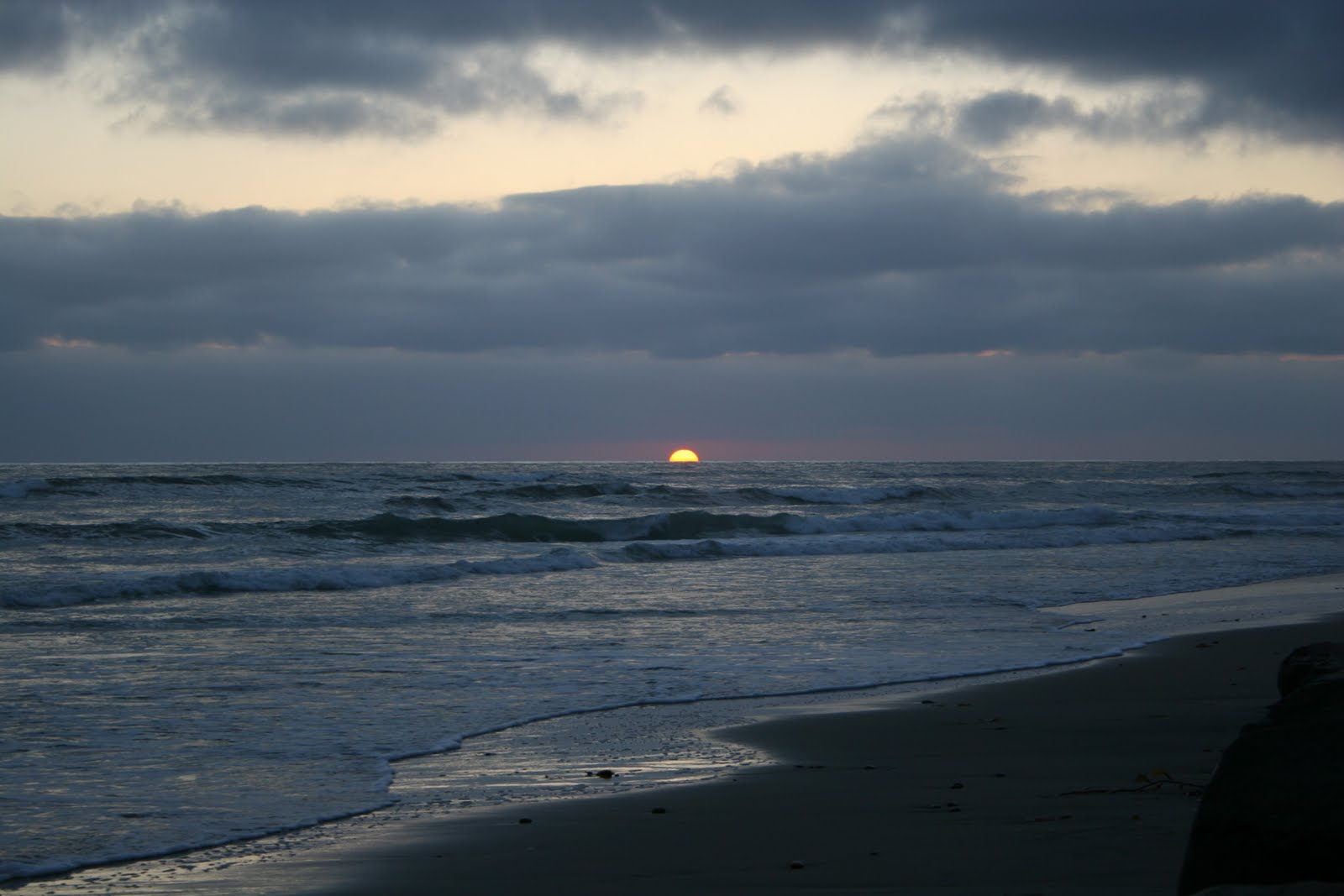 Can't help singing my 2nd favorite George Harrison tun with the alternate lyrics as our nearest stellar neighbor sinks slowly below the waves.... This image was taken with the kit lens at 55mm focal length with an exposure of 1/60 seconds at f/5.6, ISO 100.
Wednesday, June 30, 2010
Another view of a San Diego sunset
 Another view of the setting sun near Encinitas California, north of San Diego. This image was taken with the kit lens at 18mm focal length with an exposure of 1/320 seconds at f/5.6, ISO 100.
Tuesday, June 29, 2010
Sunset on the Beach
 The sunset approaches near Swami's Seaside Park north of San Diego. This image was taken with the kit lens at 18mm focal length with an exposure of 1/400 seconds at f/5.6, ISO 100.
Monday, June 28, 2010
Surfer
 With the sun approaching the horizon behind him, this surfer rides a wave on a beach near Encinitas north of San Diego. This image was taken with the kit lens at 55mm focal length with an exposure of 1/1000 seconds at f/5.6, ISO 100.
Sunday, June 27, 2010
Sleeveless the Magician
 Sleeveless the Magician does his show at Balboa Park in San Diego. If you happen to see him, be sure to stop and enjoy his magic and his humor. This image was taken with the kit lens at 30mm focal length with an exposure of 1/80 seconds at f/8, ISO 100.
Saturday, June 26, 2010
Flowers in Balboa Park
 Last Saturday I visited the Ruben H. Fleet Science Museum in San Diegos Balboa Park. Across the street was a large flower garden in whiich I found this flower. This image was taken with the kit lens at 41mm focal length with an exposure of 1/1000 seconds at f/6.3, ISO 100.
Friday, June 25, 2010
Swimming with the sharks
 While I was at the California Science Center, I got to "swim with sharks". Ok, actually, we were in the shark tunnel and he was swimming on the other side of some glass. This image was taken with my 20D and the kit lens at 31mm focal length with an exposure of 1/500 seconds at f/5.0, ISO 400.
Thursday, June 24, 2010
California Sunset
 I was in LA last Friday and stopped to watch the sunset south of LA while driving to San Diego. I didn't get to put my toes in the water Friday night, but Saturday night I made sure to take a long walk on a beach near San Diego. This image was taken with the kit lens at 55mm focal length with an exposure of 1/80 seconds at f/5.6, ISO 100.
Friday, June 11, 2010
Hey, stand still, I'm taking a long exposure!


Thursday, June 10, 2010
Sunset on Kitt Peak

Sunday, April 18, 2010
Spiderman works on the 90 inch

Saturday, April 17, 2010
Fisheye Sunset

Thursday, March 25, 2010
The 90Prime comet - another view

Wednesday, March 24, 2010
Topping the 90Prime dewar

Tuesday, March 23, 2010
Halos and domes

Monday, March 22, 2010
Halo around the dome

Sunday, March 21, 2010
Of halos and telescopes

Subscribe to:
Posts (Atom)