The view from Dead Indian Summit Overlook on Friday July 27 was quite spectacular as the view westward generally towards Yellowstone National Park show the steep mountain road on the right-center foreground and valleys and mountain ranges as we stopped here along the road between Cody Wyoming and the Northeast Entrance to the park. Along the way, the road is steep and winding before entering the valley generally to the right third of this image and heading towards Montana to the Northwest of here. You can even see some snow on the peaks just left of center on the horizon. This 8 frame panorama taken with my 24mm lens and exposures of 1/500 seconds at f/5.6, ISO 100 and was assembled with the Hugin Panorama Creator under Linux.
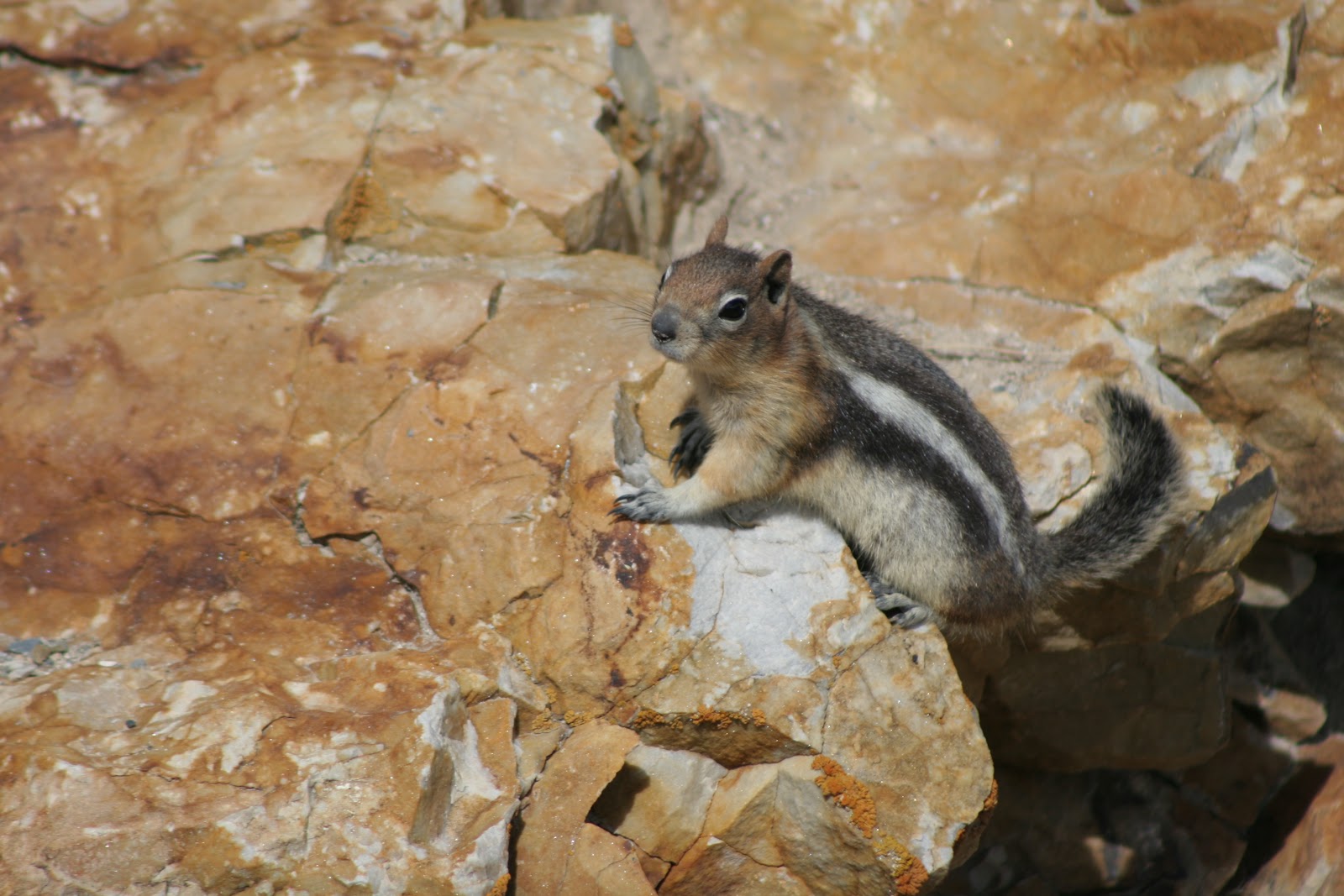
While at the overlook, quite a large crew of Chipmunks and Squirrels were there and not only entertaining fellow travelers, but happy to accept a small gratuity (of food, of course) from them. This little guy didn't want to miss out on the activities as he climbed over rocks to get to the crowd of critters and humans. This image was taken with my 75-300mm lens at 300mm focal length with an exposure of 1/800 seconds at f/5.6, ISO 100.
This picture is a 2nd squirrel munching a potato chip given to him by one of the other tourists. Both these guys were around 5 inches long (head and body less the tail) and I suspect they are Sierra Nevada Golden-Mantled Ground Squirrels. This image was taken at 300mm focal length with an exposure of 1/800 seconds at f/5.6, ISO 100.
I didn't get a very good shot of the little guy below. He's got the pointier snout of a chipmunk along with the markings on his head and he was a little smaller than the other critters. This shot was taken at 300mm focal length with an exposure of 1/1000 seconds at f/5.6, ISO 100.
Click on a photo to see a larger version of the image.
Tuesday, August 21, 2012
Monday, August 20, 2012
Campground views
After our late afternoon visit to Old Faithful in Yellowstone National Park on Thursday July 26, we drove east past Yellowstone Lake and out the East Entrance towards Cody Wyoming - a place I'd visited during one of my families trips between Oregon and Michigan when I was 8 years old. We found a campground with a couple empty camp sites well after dark at the Newton Creek Campground along the North Fork of the Shoshone River. We were greeted by these views in the morning when we finally saw our surroundings in sunlight. The steep hills and cliffs in the area are composed of sandstone debris flows with many sharp features including at least one window and one cave (see below) visible from this campground. The image above is a panorama composed of 4 portrait format images taken with my 24mm lens with exposures of 1/1250 seconds at f/4, ISO 400.
Just off the left edge of the panorama above was this small cave feature near the top center. This first image shows the setting for the next two and was taken with my 24mm lens with an exposure of 1/125 seconds at f/5.6, ISO 100.
Zooming in some, you can see more detail along with hints of many of the features on the cliffside in which this cave sits. This image was taken with my 75-300mm zoom at 75mm focal length with an exposure of 1/125 seconds at f/5.6, ISO 100.
Finally, zoomed in to 300mm focal length, you can see the cave interior as well as the sharp hoodoos on the left as well as along the top of the cliff and some coarse layering in the sandstone cliffs below the cave. This image was taken with an exposure of 1/320 seconds at f/5.6, ISO 400.
Just off the left edge of the panorama above was this small cave feature near the top center. This first image shows the setting for the next two and was taken with my 24mm lens with an exposure of 1/125 seconds at f/5.6, ISO 100.
Zooming in some, you can see more detail along with hints of many of the features on the cliffside in which this cave sits. This image was taken with my 75-300mm zoom at 75mm focal length with an exposure of 1/125 seconds at f/5.6, ISO 100.
Finally, zoomed in to 300mm focal length, you can see the cave interior as well as the sharp hoodoos on the left as well as along the top of the cliff and some coarse layering in the sandstone cliffs below the cave. This image was taken with an exposure of 1/320 seconds at f/5.6, ISO 400.
Sunday, August 19, 2012
Old Faithful
Old Faithful erupted just about right on schedule. Ok, it was maybe a minute or two early. The last time I was in Yellowstone and saw Old Faithful was in 1968 when my family stopped here on the way from Oregon to Michigan. The place has really built up in 44 years and seems a lot more crowded than I remember. This image was taken with my 24mm lens with an exposure of 1/100 seconds at f/16, ISO 100.
Saturday, August 18, 2012
The Firehole River
The Firehole River runs past Old Faithful and the Upper Geyser Basin, Midway Geyser Basin and the Lower Geyser Basin before meeting the Gibbon River and turning into the Madison River. This view is from a bridge at the start of the Fairy Falls trail. This image was taken with my 75-300mm lens at 75mm with an exposure of 1/250 seconds at f/8, ISO 100.
Friday, August 17, 2012
Clepsydra Geyser
Thursday, August 16, 2012
Fountain Paint Pot and nearby thermal features.
Wednesday, August 15, 2012
Silex Spring & Bacterial Mats
| Someone dropped their hat into the Bacterial Mats - I would have left my favorite hat there too.... This image was taken at 300mm focal length with an exposure of 1/500 seconds at f/8, ISO 100. |
Tuesday, August 14, 2012
Madison River pan
As we entered Yellowstone National Park via the west entrance, we almost immediately began following the Madison River. With storm clouds in the east, I had to stop and take pictures of this almost calm river. This pan was generated from 6 images taken with my 24mm lens.
Monday, August 13, 2012
The Three Buttes
![]() |
| On our way from Craters of the Moon National Monument to Yellowstone National Park, we stopped along the road to look at the Three Buttes. From left to right is East Butte, Middle Butte and Big Butte. Big Butte can be seen from Craters of the Moon for example in this image taken from near the Campground that I published on this blog recently. This is a panorama assembled from seven images taken with my 24mm lens on my 20D. |
Sunday, August 12, 2012
The lone tree on top of Inferno Cone - take II
Saturday, August 11, 2012
The Great Rift
Friday, August 10, 2012
Hiking among the lava flows
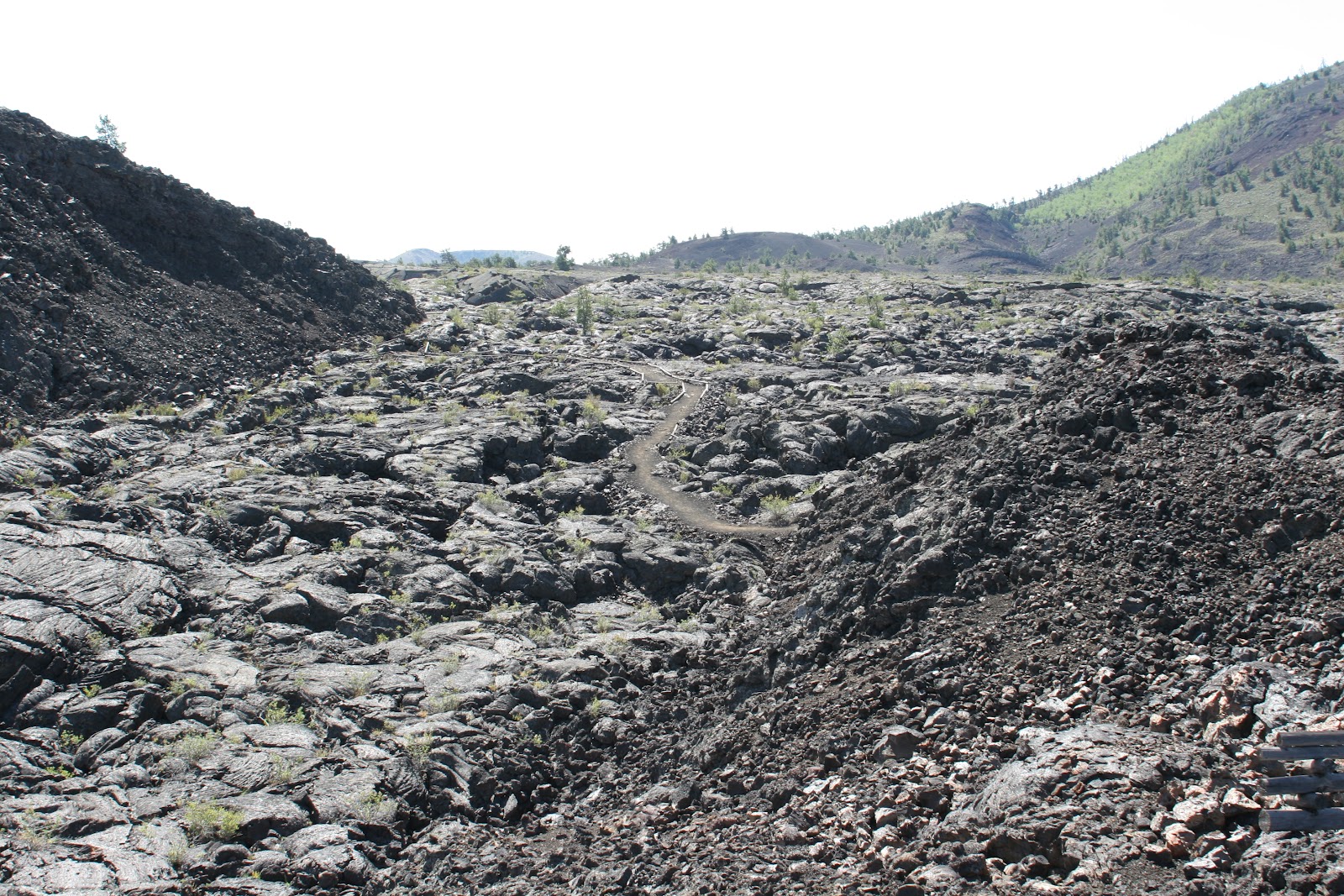
| This is a Pahoehoe flow along the trail. You can see a bluish tint to some of the surface layer. The image was obtained with my 24mm lens with an exposure of 1/200 seconds at f/8, ISO 100. |
| The section of this Pahoehoe lava was pushed up after it cooled so that you can see the layering inside. This image was taken with my 24mm lens and an exposure of 1/160 seconds at f/8, ISO 100. |
Thursday, August 09, 2012
Buffalo Lava Caves, Craters of the Moon National Monument
Wednesday, August 08, 2012
Interesting rock structures
Walking around on lava flows finds lots of interesting features - here are regular fractures in basaltic lava flows near Broken Top cinder cone. These fractures are similar to those found at the Giants Causeway in Northern Ireland or Devils Tower in Wyoming, though with different shaped fractures and not as long a column as those well known structures. It is likely caused by rapid cooling of the lava flows and these square patterns were visible over a large area. The area is not far from some lava caves (see my next post!). This image was taken with my 24mm lens with an exposure of 1/100 seconds at f/8, ISO 100.
Monday, August 06, 2012
Lava and cinder everywhere
These three shots show some of the variety in the lava fields around the base of Broken Top cinder cone at Craters of the Moon National Monument. The first image shows a tilted layer of lava with a coating of cinder. The last image shows some Pahoehoe lava flows. The area is littered with debris from nearby spatter cones. All the images were taken with a 24mm lens on my 20D, the first two with exposures of 1/2000 seconds at f/5 and the last 1/1250 seconds at f/5, all at ISO 400.
Sunday, August 05, 2012
Broken Top lava flow panorama, Craters of the Moon National Monument
This partial panorama is from 8 images taken with my 24mm lens with an exposure of 1/2500 seconds at f/5, ISO 400. This image looks over The Broken Top lava flow from the side of Broken Top cinder cone along the loop trail at the Big Sink Overlook. The view is generally towards the north with a complex of cinder cones on the left including Inferno Cone, Snow Cone and Spatter Cones.
Saturday, August 04, 2012
A pretty sunset
Sunset from the top of Inferno Cone was quite spectacular, complete with crepuscular rays to go with the clouds. This image was taken with my 24mm lens with an exposure of 1/3200 seconds at f/5, ISO 400.
Friday, August 03, 2012
The lone tree on top of Inferno Cone
Just before sunset, we hiked up Inferno Cone, a cinder cone near the center of Craters of the Moon. The trail heads straight up the side of the cinder cone and looks short - until you get to the shoulder in the hill about halfway up. There is a great view of the area from the summit, which is in the red rocks where I stood to take this image. This lone tree is visible on top of this cinder cone from all over the park. There are some trees below it on the hillside and some remains of other similar trees on the summit, but it is the only one presently on top. This image was taken with my 24mm lens with an exposure of 1/200 seconds at f/5, ISO 400.
Thursday, August 02, 2012
Craters of the Moon Lava
This view from the edge of the North Crater lava flows shows the brown and grey color of the A'a lava. In the distance is 300,000 year old Big Butte from much earlier volcanic activity. Craters of the Moon has been active from about 15,000 years ago to about 2,000 years ago and may continue its activity in the future. Unlike nearby Yellowstone, Craters of the Moon is a rift volcano with many small cinder cones and spatter cones issuing long lava flows. The activity is concentrated along the "Great Rift" which runs along a roughly N-S line through the area. This image was taken with my 24mm lens with an exposure of 1/250 seconds at f/8, ISO 100.
It was interesting to look closely at the lava rocks This closeup was taken with my Nexus Android smartphone camera looking through my 10x hand magnifier.
|
Wednesday, August 01, 2012
North Crater Cinder Cone at Craters of the Moon
This was the view across the North Crater lava flow to North Crater Cinder Cone from our campsite in the Craters of the Moon National Monument campground last Tuesday. This image was taken with my 75-300mm zoom at 75mm focal length with an exposure of 1/320 seconds at f/4, ISO 100.
Tuesday, July 31, 2012
New Neighbors
After a day of driving, we pulled into our campsite at Craters of the Moon National Monument. This little guy was checking out his new neighbors from the adjacent lava fields. He made quite a racket with his chirping - almost sounded like a bird when I first heard him rather than the squirrel he was. This image was taken with my 75-300mm lens at 300mm focal length with an exposure of 1/125 seconds at f/5.6, ISO 100.
Tunnel Arch and Pine Tree Arch
Tunnel Arch is along a side trail off the main Devils Garden trail at the end of the main road into Arches National Park. I'm not sure which of these two arches is Tunnel Arch - they both go through though the one of the left is smaller and has a ceiling opening into the rock above it, so I suspect it is the larger one on the right. This image was taken with my 24mm lens with an exposure of 1/50 seconds at f/5, ISO 100.
Pine Tree Arch was the last one we visited on this hike into the Devils Garden trail area and is not too far beyond Tunnel Arch on the side trail off the Devils Garden trail. You can even see it from the crest of the trail before it drops into the valley below. If you look closely at the rock at the top of the opening in the arch, you can see lots of cracks that makes me think that only the slight "V" shape of the area and that the crack on the right doesn't go all the way through to the other side of the fin the arch is in is the only thing keeping these blocks of rock from falling and enlargening the arch. I ran through the window in the arch quickly to minimize the probability that I would be under the block when it eventually falls.... This image was taken with my 10mm fisheye lens with an exposure of 1/80 seconds at f/2.8, ISO 100.
Sand Dune Arch
Monday, July 30, 2012
Landscape Arch panorama
This is a mini panorama of Landscape Arch in Arches National Park. With my 24mm lens, I could not quite get the whole arch in one shot, but a left-center-right set worked great. This arch is the longest in the world and has shown some signs of its eventual demise when a large chunk of rock fell from it in 1991. As the rangers in the park said: See it while you can!
Subscribe to:
Posts (Atom)