Click on a photo to see a larger version of the image.

Wednesday, August 15, 2012

Silex Spring & Bacterial Mats

This is an image of pretty blue Silex Spring along the short Fountain Paint Pot Trail along the road about midway between Madison and Old Faithful.  This image was taken with my 10mm fisheye lens with an exposure of 1/400 seconds at f/8, ISO 100.

Along the boardwalk from the parking lot you can see the Bacterial Mats below the steaming (even in summer, so you can imagine how hot the water is!) Silex Spring.  This image was taken with my 75-300mm zoom at 75mm focal length.  The exposure of 1/500 seconds at f/8, ISO 100.

Someone dropped their hat into the Bacterial Mats - I would have left my favorite hat there too....  This image was taken at 300mm focal length with an exposure of 1/500 seconds at f/8, ISO 100.

Tuesday, August 14, 2012

Madison River pan

As we entered Yellowstone National Park via the west entrance, we almost immediately began following the Madison River.  With storm clouds in the east, I had to stop and take pictures of this almost calm river.  This pan was generated from 6 images taken with my 24mm lens.

Monday, August 13, 2012

The Three Buttes

On our way from Craters of the Moon National Monument to Yellowstone National Park, we stopped along the road to look at the Three Buttes.  From left to right is East Butte, Middle Butte and Big Butte.  Big Butte can be seen from Craters of the Moon for example in this image taken from near the Campground that I published on this blog recently.  This is a panorama assembled from seven images taken with my 24mm lens on my 20D.

Sunday, August 12, 2012

The lone tree on top of Inferno Cone - take II

You can see the lone tree on top of Inferno Cone in this view from the loop road heading back to the entrance area of Craters of the Moon National Monument.  You can also see the shoulder on the right flank of Inferno Cone that fools climbers into thinking they've got a short hike to the summit ahead of them. This image was taken with my 24mm lens and an exposure of 1/160 seconds at f/8, ISO 100.

Saturday, August 11, 2012

The Great Rift

This panorama was assembled from 9 images taken with my 24mm lens on my 20D during our visit to Craters of the Moon National Monument at the end of our Ranger led Broken Top Hike more than 2 weeks ago.  It shows a section of the "Great Rift", a  fracture that is the cause of the Craters of the Moon lava flows.  You can trace the sources of the lava flows to sources right along the Great Rift, from its north end to its south end.

The leftmost image from the pan shows the flank of Broken Top cinder cone on the right as well as distant cones in the background that run along the Great Rift to the north.  This image was taken with my 24mm lens on my 20D and an exposure of 1/160 seconds at f/8, ISO 100.

The rightmost image in the pan shows the flank of Broken Top cinder cone on the left as well as the flank of Big Cinder Butte on the right with the Great Rift running generally southward towards the cinder cone.  This image was taken with my 24mm lens looking into the sun with an exposure of 1/100 seconds at f/8, ISO 100.

Friday, August 10, 2012

Hiking among the lava flows

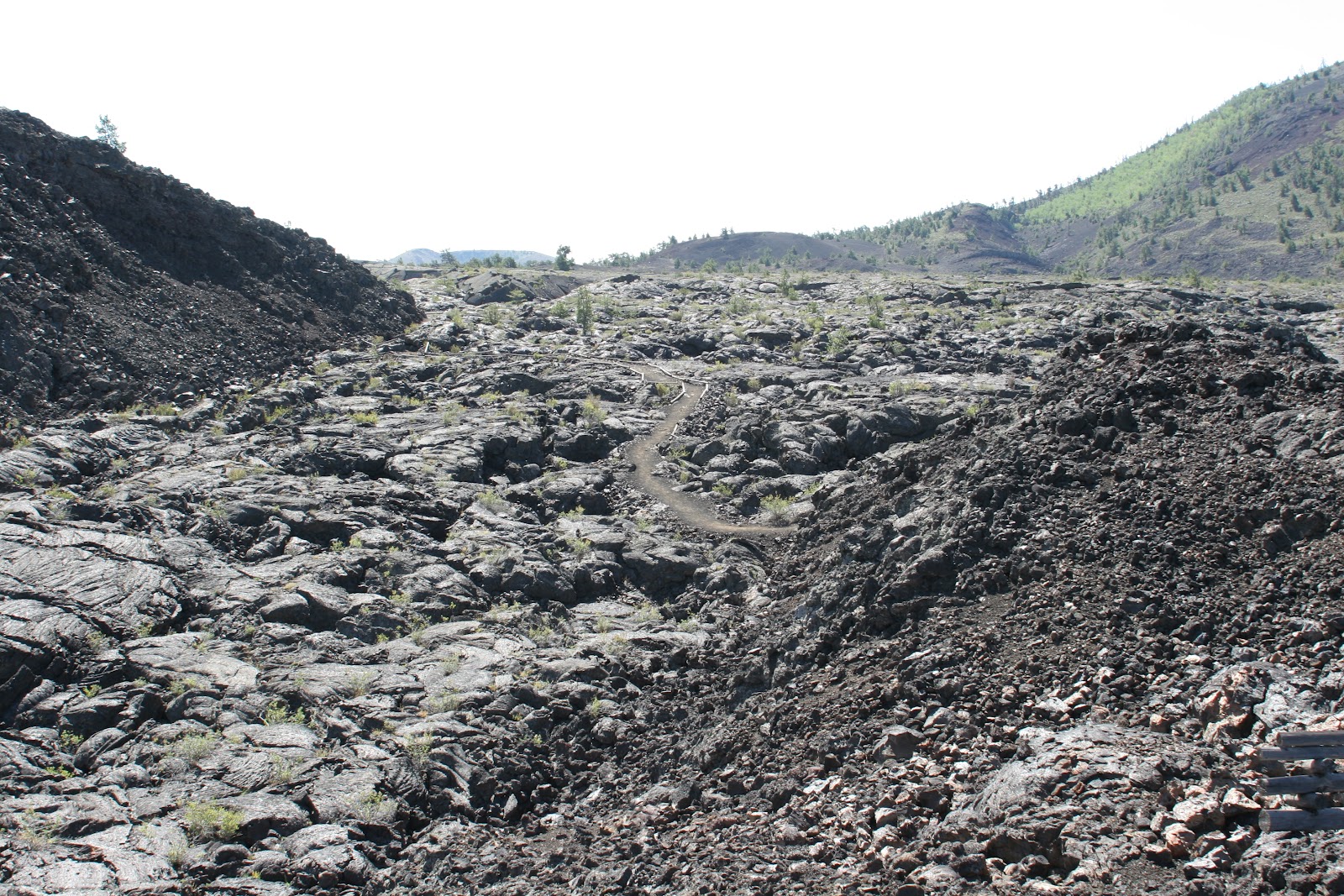
Our group, led by Craters of the Moon park ranger Rebecca, hikes along the trail at the base of Broken Top cinder cone with Pahoehoe lava flows to their left. This image was taken with my 24mm lens and an exposure of 1/200 seconds at f/8, ISO 100.

This panorama shows the lava flows between Broken Top cinder cone (behind the photographer) and Big Cinder Butte at the left in this pan.  This image was built from 7 frames taken with my 24mm lens on my 20D.

This is a Pahoehoe flow along the trail.  You can see a bluish tint to some of the surface layer.  The image was obtained with my 24mm lens with an exposure of 1/200 seconds at f/8, ISO 100.

The section of this Pahoehoe lava was pushed up after it cooled so that you can see the layering inside.  This image was taken with my 24mm lens and an exposure of 1/160 seconds at f/8, ISO 100.

Thursday, August 09, 2012

Buffalo Lava Caves, Craters of the Moon National Monument

Entering the cave - not too much clearance!  I bumped my head a couple times....  We left most of our backpacks at the entrance.  This image taken with my 24mm lens with an exposure of 1/250 seconds at f/8, ISO 100.
A view of some of the stalactites hanging from the ceiling of the lava cave - these are not caused by the usual dripping calcium Carbonate but instead by the rock on the cave wall melting in the heat of the lava flowing through the cave below it.  This image was taken with my 24mm lens with an exposure of 1/800 seconds at f/1.8, ISO 3200 with a flashlight illuminating the central part of the image.

A view of more stalactites in the lava cave - smaller in this case than the first image.  This image is the combination of 2 images each with the flashlight pointed at slightly different parts of the ceiling , the exposures were 1/50 and 1/200 seconds, both at f/1.8, ISO 3200 with my 24mm lens.

Looking back at the entrance to the cave.  You can see the rough surface of the ceiling, covered in stalactites as well as the complex structure of the floor.  This image was taken with my 24mm lens with an exposure of 1/60 seconds at f/1.8, ISO 3200.


These last two photos are different views of the same section of a collapsed cave section.  The ceiling was around 3 or 4 feet thick before its collapse.  In the upper image, you can see some horizontal banding in the cave wall which  are the result of lava flows of differing depths when this was an active lava tube.  I forgot to reset my camera for outdoors shooting after climbing out of the cave, so the first image was taken at 1/4000 seconds at f/1.8, ISO 3200, the 2nd (after the D'Oh! moment) was taken at 1/25 seconds at f/8, ISO 100, both with my 24mm lens.


Wednesday, August 08, 2012

Interesting rock structures

Walking around on lava flows finds lots of interesting features - here are regular fractures in basaltic lava flows near Broken Top cinder cone.  These fractures are similar to those found at the Giants Causeway in Northern Ireland or Devils Tower in Wyoming, though with different shaped fractures and not as long a column as those well known structures.  It is likely caused by rapid cooling of the lava flows and these square patterns were visible over a large area.  The area is not far from some lava caves (see my next post!).  This image was taken with my 24mm lens with an exposure of 1/100 seconds at f/8, ISO 100.

Monday, August 06, 2012

Lava and cinder everywhere


These three shots show some of the variety in the lava fields around the base of Broken Top cinder cone at Craters of the Moon National Monument.  The first image shows a tilted layer of lava with a coating of cinder.  The last image shows some Pahoehoe lava flows.  The area is littered with debris from nearby spatter cones.  All the images were taken with a 24mm lens on my 20D, the first two with exposures of 1/2000 seconds at f/5 and the last 1/1250 seconds at f/5, all at ISO 400.

Sunday, August 05, 2012

Broken Top lava flow panorama, Craters of the Moon National Monument

This partial panorama is from 8 images taken with my 24mm lens with an exposure of 1/2500 seconds at f/5, ISO 400.  This image looks over The Broken Top lava flow from the side of Broken Top cinder cone along the loop trail at the Big Sink Overlook.  The view is generally towards the north with a complex of cinder cones on the left including Inferno Cone, Snow Cone and Spatter Cones.

Saturday, August 04, 2012

A pretty sunset

Sunset from the top of Inferno Cone was quite spectacular, complete with crepuscular rays to go with the clouds.  This image was taken with my 24mm lens with an exposure of 1/3200 seconds at f/5, ISO 400.

Friday, August 03, 2012

The lone tree on top of Inferno Cone

Just before sunset, we hiked up Inferno Cone, a cinder cone near the center of Craters of the Moon.  The trail heads straight up the side of the cinder cone and looks short - until you get to the shoulder in the hill about halfway up.  There is a great view of the area from the summit, which is in the red rocks where I stood to take this image.  This lone tree is visible on top of this cinder cone from all over the park.  There are some trees below it on the hillside and some remains of other similar trees on the summit, but it is the only one presently on top.  This image was taken with my 24mm lens with an exposure of 1/200 seconds at f/5, ISO 400.

Thursday, August 02, 2012

Craters of the Moon Lava

This view from the edge of the North Crater lava flows shows the brown and grey color of the A'a lava.  In the distance is 300,000 year old Big Butte from much earlier volcanic activity.  Craters of the Moon has been active from about 15,000 years ago to about 2,000 years ago and may continue its activity in the future.  Unlike nearby Yellowstone, Craters of the Moon is a rift volcano with many small cinder cones and spatter cones issuing long lava flows.  The activity is concentrated along the "Great Rift" which runs along a roughly N-S line through the area.  This image was taken with my 24mm lens with an exposure of 1/250 seconds at f/8, ISO 100.


It was interesting to look closely at the lava rocks  This closeup was taken with my Nexus Android smartphone camera looking through my 10x hand magnifier.

This shows the rock as a whole - the closeup area is near the middle top of the rock in this orientation.  The rock is rotated a little counter clockwise from the view through the magnifier above.  This image was also taken with my Nexus Android smartphone camera.

Wednesday, August 01, 2012

North Crater Cinder Cone at Craters of the Moon

This was the view across the North Crater lava flow to North Crater Cinder Cone from our campsite in the Craters of the Moon National Monument campground last Tuesday.  This image was taken with my 75-300mm zoom at 75mm focal length with an exposure of 1/320 seconds at f/4, ISO 100.

Tuesday, July 31, 2012

New Neighbors

After a day of driving, we pulled into our campsite at Craters of the Moon National Monument.  This little guy was checking out his new neighbors from the adjacent lava fields.  He made quite a racket with his chirping - almost  sounded like a bird when I first heard him rather than the squirrel he was.  This image was taken with my 75-300mm lens at 300mm focal length with an exposure of 1/125 seconds at f/5.6, ISO 100.

Tunnel Arch and Pine Tree Arch

Tunnel Arch is along a side trail off the main Devils Garden trail at the end of the main road into Arches National Park.  I'm not sure which of these two arches is Tunnel Arch - they both go through though the one of the left is smaller and has a ceiling opening into the rock above it, so I suspect it is the larger one on the right.  This image was taken with my 24mm lens with an exposure of 1/50 seconds at f/5, ISO 100.
Pine Tree Arch was the last one we visited on this hike into the Devils Garden trail area and is not too far beyond Tunnel Arch on the side trail off the Devils Garden trail.  You can even see it from the crest of the trail before it drops into the valley below.  If you look closely at the rock at the top of the opening in the arch, you can see lots of cracks that makes me think that only the slight "V" shape of the area and that the crack on the right doesn't go all the way through to the other side of the fin the arch is in is the only thing keeping these blocks of rock from falling and enlargening the arch.  I ran through the window in the arch quickly to minimize the probability that I would be under the block when it eventually falls....  This image was taken with my 10mm fisheye lens with an exposure of 1/80 seconds at f/2.8, ISO 100.

Sand Dune Arch


Sand Dune Arch in Arches National Park is a short and easy hike into a narrow canyon between two fins of sandstone.  The hard part of the hike is the soft sand but the tall canyon walls makes the area cooler than other more exposed hikes elsewhere in the park.  This image was taken with my 24mm lens with an exposure of 1/50 seconds at f/5, ISO 100.

Monday, July 30, 2012

Landscape Arch panorama

This is a mini panorama of Landscape Arch in Arches National Park.  With my 24mm lens, I could not quite get the whole arch in one shot, but a left-center-right set worked great.  This arch is the longest in the world and has shown some signs of its eventual demise when  a large chunk of rock fell from it in 1991.  As the rangers in the park said: See it while you can!

Delicate Arch at Arches National Park

We spent the last week on a road trip from Tucson up to Yellowstone National Park via several other parks along the way.  We arrived at Arches National Park on Tuesday last week. This view of Delicate Arch was taken from the upper viewpoint about a mile away.  It was created by doing an HDR combine of 3 images  at -1 stop, 0 and +1 stop from the nominal metered exposure that would have been at 1/800 seconds at f/8, ISO 200.  The exposures were obtained with my 75-300mm zoom at 300mm focal length.  Note the person standing next to the arch to get an idea of the size of it.  This is the most famous Arch in the park and is the Utah state symbol.  Below is an HDR combination of three images using my 24mm lens with -1, 0, +1 stop exposures showing the general setting of Delicate Arch:

Tuesday, June 05, 2012

Venus Transit, 2012 June 5

I watched the Venus transit from the UofA mall in front of the Lunar and Planetary Lab where quite a few folks were set up to watch the event.  Here, some grad students set up a "Sunspotter" which worked really well, allowing a small group to watch the event simultaneously (while through telescopes, only one person could view the sun at a time).

Zooming in on the image of the sun, you can see Venus on the right side of this image (which is roughly correct N-S, but flipped E-W so Venus is actually on the NE part of the sun), just about to finish transiting onto the face of the sun about 20 minutes after the start of the transit.


A bit later, I had the opportunity to look through a telescope with an H-alpha filter which showed some prominences, sunspots and lots of other phenomena along with the silhouetted Venus.


KGUN-9 weatherperson Erin Christiansen was on site as well. Here, she talks to my friend Dean Ketelsen who had set up a couple of telescopes for visitors to look through.


Here a young girl looks through one of the small telescopes.


Venus was big enough to see as a small speck on the sun even with just a pair of solar viewing glasses as this young lady demonstrates:


I borrowed a larger solar viewing filter that fit over my 75-300 zoom lens and took this shot just holding the filter over the lens.  Focusing and setting the exposure were both challenging.  For reference, this was heavily cropped from the original frame shot at 300mm focal length with an exposure of 1/500 seconds at f/5.6, ISO 400.


Sunday, May 27, 2012

A sunrise at sunset

After eclipse maximum during the May 20 Annular eclipse, we watched the sun setting over the local horizon as the sun rose over the distant lunar mountains.  This image was taken of the projected image at the McMath Solar Telescope with an exposure of 2 seconds at f/2.8 at ISO 400 with my 24mm lens.

Saturday, May 26, 2012

The Moon, the sun and a sunspot

We watched the partial eclipse from the McMath Solar Telescope on Kitt Peak and enjoyed watching as several sunspots approached the lunar limb and disappeared.  A few things you can see in this image are a fair amount of detail in the sunspot.  There's also some granulation in the surface of the moon.  And you can see the ruggedness of the lunar limb as mountains and craters are abundant there.  This shot of the projected eclipse image from the main beam of the McMath Solar Telescope was taken at 1/2000 seconds at f/5.6, ISO 400.

Friday, May 25, 2012

Annular Eclipse from Kitt Peak

During last weekends Annular Total eclipse, I was "stuck" observing on Kitt Peak.  We were in the path of a partial eclipse that day of about 85% at max about 40 minutes before sunset.  I managed to "sneak" into the McMath Solar Telescope where the day's observers were busy making observations of the sun during the eclipse.  They projected an image onto the wall for about 15 of us to watch throughout the entire visible eclipse.  Here, as the sun starts to get low in the sky, we watch as the sun emerges from behind the sun. This image was taken with my 10mm fisheye with an exposure of 3 seconds at f/2.8, ISO 400.

Thursday, April 26, 2012

Witchcraft on final

B-24 WW-II bomber "Witchcraft" is on final into Marana Regional Airport after about a half hour flight around the area.  This image was taken with my 75-300 zoom with an exposure of 1/640 seconds at f/5.6, ISO 100, 300mm focal length.

Wednesday, April 25, 2012

Under the B-24 wing

While trying to stay out of the 100 degree heat, I found shade under the wing of the B-24 "Witchcraft" and discovered this view of the other two planes, the B-17 Nine O Nine and the P-51 Betty Jane are visible.  This image was taken with my 10mm fisheye lens with an exposure of 1/250 seconds at f/8, ISO 100.

Tuesday, April 24, 2012

Betty Jane

Betty Jane is a P-51 Mustang that was on hand at the Marana Regional Airport the weekend of April 20-22, 2012 along with B-24 Witchcraft (visible in the background at right) and B-17 Nine O Nine.  This image was taken with my 10mm fisheye lens with an exposure of 1/400 seconds at f/8, ISO 100.

B-17 Nine O Nine


The B-17 Nine O Nine was on display at the Marana Regional Airport April 20-22.  This view of the bomber was taken with my 10mm fisheye with an exposure of 1/250 seconds at f/8, ISO 100.