Click on a photo to see a larger version of the image.
Showing posts with label Sunset. Show all posts

Tuesday, August 07, 2018

Mars rising over the Dragoons

Mars rises over the Dragoon Mountains from our ranch  in the foothills west of the Dragoons.  Mars is just right of center and there's a nice rainstorm in the twilight skies off to the right.  This is a 5 image HDR combine using a 2 stop exposure sequence using my 17-70mm Sigma lens on my Canon 70D.


Mars is easier to see in this image taken a bit later than the one above, again an HDR combine using a 2 stop exposure sequence with my 17-70mm Sigma lens on my Canon 70D.

Thursday, January 04, 2018

Kitt Peak Sunset.

Sunset o Kitt Peak on December 27, 2017.  This is an HDR combine showing a view similar to what I saw in real time.  This is a combine of 5 exposures with my 50mm f/1.8 lens attached to my Canon 6D.

Wednesday, November 22, 2017

Desert Sunset - Tucson Mountain Park

Kitt Peak in the distance
I drove over Gates Pass road into the desert just west of Gates Pass in Tucson Mountain Park for the sunset yesterday.  This first image is the view looking west with Kitt Peak in the center of the image.  This is an HDR combine of 5 images showing not only the brighter sky and distant mountains, but also the darker foreground plants.  I used Aurora HDR program for the combine.  The image was taken with my Canon 6D and the Canon 50mm f/1.8 lens.  Exposures ranged at f/4 at ISO 800 from 1/1600 seconds to 1/100 seconds.

Gates Pass to Golden Gate Mountain
 This image is looking back along Gates Pass Road with the pretty mountains ranging from Golden Gate Mountain on the right to the dip of Gates Pass on the left edge of the image.  The image is an HDR combine with 5 images taken with my Canon 6D and 50mm f/1.8 lens at f/4, ISO 800 with exposures ranging from 1/200 seconds to 1/13 seconds.

Saguaro Cactus and pretty sunset clouds
 This image looks west into the setting Sun with silhouetted cacti and bushes in the desert.  This HDR combine of 5 images taken with my Canon 6D and 50mm f/1.8 lens and exposures of  1/1250 to 1/80 seconds.

Saguaro Cactus, sunset clouds and the Moon
This last image is similar to the previous one but in portrait mode to catch the crescent Moon in the sky overhead.  It is also an HDR combine of 5 images with my Canon 6D and 50mm f/1.8 lens and exposures of 1/800 to 1/50 seconds.

Monday, July 17, 2017

Monsoon Storm from Kitt Peak

Last night while between local storms on Kitt Peak, I watched some storms around the area.  This one to the northwest of Kitt Peak was quite pretty and spectacular at the same time.  I took a series of five exposures in an HDR sequence and this is the middle exposure at ISO 400, f/8, 1/400 seconds at a focal length of 17mm on my Canon 70D.

This is a combination of 5 frames from 1/1000 second to 1/160 second exposures which shows the range of activity from the rays from the sun behind the clouds to the mountains and valley in the foreground.  Note the area in between the anvil and the local mountains which is covered in water from rainfall in that area.

Sunday, May 28, 2017

A colorful Kitt Peak sunset

The view of sunset from Kitt Peak can be quite spectacular.  Of course, a pretty cloud filled sunset does not normally bode well for the nights observing program....

 This Sun Dog was visible at about the same time as the first image.

Just after sunset, this deep red glow was quite spectacular.

Monday, July 13, 2015

Colorful sunset


Here are two views of last nights sunset from our backyard, both taken with my Galaxy Note 4's camera with different white balances.  The shadows on the upper clouds caught my attention first and you can see them change over the 5 minutes or so between the two shots.  You can also see virga from the clouds below.  I am almost spoiled by the extra processing that my cell phone camera can do even before the images are stored compared to what I might need to do after the shot with my "real camera".  According to the image information, the exposures were f/2.2, 1/121 seconds, 4.8mm focal length and ISO 40 for the first image and f/2.2, 1/30 seconds, 4.8mm focal length and ISO 64 for the 2nd exposure.  I think the first was in auto white balance and both used HDR mode for the exposure.

Thursday, July 03, 2014

T-Storm threatening Tucson


On the way home last night just before sunset, I saw a potential thunderstorm coming in to Tucson from the southeast so I took a detour up to A Mountain (aka Sentinal Peak).  It's got such a pretty view of Tucson.  This image was taken with my Canon 70D and my new 18-250mm Sigma lens at 18mm focal length.  The exposure was 1/60 seconds at f/5, ISO 400 and it was the central image in a set of 5 shots that I turned into a panorama seen below.


This panorama was stitched together with Hugin Panorama Creator using essentially the default batch settings.


This image was taken later as a time exposure with an ND2 filter.  The exposure was 30 seconds at f/16, ISO 100 with my lens at 18mm focal length.  This image is looking southeast, not far from the direction of the first image above.  I wasn't thinking or I would have made another panorama, but I didn't take the other 4 images....

Thursday, March 20, 2014

A Canyon Sunset from Desert View


We watched the sunset during our Grand Canyon trip last month from next to the Watchtower at Desert View near the eastern entrance to the Grand Canyon.  I was hoping for a more colorful sunset, but the nearly completely overcast sky limited the colors present.  Here are a couple HDR combines, the first looking west into the canyon below the main visitors center on the South Rim.  I combined 5 exposures at 1 stop offsets centered on the metered proper exposure.  The shortest exposure which allowed the brightly lit sun to be visible in the sky was 1/45 seconds at f/6.7, ISO 200.  The longest exposure was 1/3 seconds at f/6.7, ISO 200.  All with my 24mm lens and the camera was on a tripod.


This view upriver produced some spectacular colors.  The view of the river in the bottom of the canyon was also quite spectacular.  This HDR combine used 5 exposures from the shortest of 1/30 seconds at f/6.7, ISO 200 to 1/2 seconds at f/6.7, ISO 200 with my 24mm lens on my 70D.

Tuesday, February 04, 2014

Colorful sunset on Kitt Peak


This fisheye view looking south from the Steward Observatory 90 inch Bok Telescope was taken after the sun had set but while the sky was still brightly lit.  This HDR combine is of 5 images taken with my 10mm lens set to f/8 and the camera at ISO 400.  The exposures were at 1 stop intervals from 1/180 seconds to 1/10 seconds.


This view of the setting sun shows a pretty sunset - unless you're planning to use one of the large telescopes on Kitt Peak like we were - namely the Steward Observatory 90 inch Bok Telescope.  Luckily, it cleared enough later to be a productive night.  This is an HDR combine of 5 images at 1 stop intervals of exposure from 1/2000 seconds to 1/125 seconds with my 24mm lens at f/8 and my 70D set to ISO 400.

Saturday, December 28, 2013

Kitt Peak sunset silhouette

I was thinking it would be fun to get the sun setting right behind Kitt Peak, but the location west of Tucson along Kinney Road in Tucson Mountain Park was a bit too far north so that the Sun set on the northern flank of the Coyote Mountains that lie just east of Kitt Peak, near the right edge of this image.  With the harsh sunset lighting, I used some HDR combines of a set of 5 images to get the best range in the image.

This first HDR combine uses the Ashikhmin operator and displays the colors in the sky nearly as I saw them.  The 5 exposures that went into the combine range from 1/3000 sec at f/16, ISO 800 with my 75-300mm telephoto lens at 250mm focal length to 1/180 seconds at f/16, ISO 800.

This HDR combine using the same 5 images mutes the colors with a Mantiuk 06 operator but shows detail in the mountain rainge that is not visible in the more saturated version.

HDR Sunset

I was out playing with my new camera again at sunset tonight.  Here are a couple HDR combines (using auto exposure bracketing in the camera and a sequence of 5 shots and Luminance HDR on my Linux box for the combine)  of the desert landscape looking west into the sunset.  It's amazing how different the combines can be.

 I liked this shot because it has a lot of color saturation.  Most of the foreground detail are only visible in the longest exposure so I was very pleased at how it appears here.  With the bright sun, the shortest exposures that show the halo of sunlight show very little else.  This view is not too far from what my eye saw while composing the shot - the human eye and brain is excellent at being able to see this type of scene.  The shortest exposure was 1/8000 seconds at f/8, ISO 100 using my 24mm f/1.8 lens on my 70D.  The mid exposure was 1/2000 seconds at f/8, ISO 200.  The longest exposure was 1/250 seconds at f/8, ISO 200.  The HDR combine was a fattal operator.

This HDR combine is a Mantiuk '06 combine of the same 5 images as the previous image.  The low saturation almost gives the appearance of there being snow on the ground.

Friday, December 20, 2013

Pretty sunset clouds

The weather on Friday was rainy and cloudy, but it partially cleared around sunset with these spectacular clouds to the north of the UofA campus.  The white building at center is the National Optical Astronomy Observatories headquarters and this area is the center of the Astronomical capital of the world with the Lunar and Planetary Lab where I work on the right edge of this fisheye view and Steward Observatory on the left edge.  Behind me is the Flandrau Science Center and planetarium. This image was taken with my 10mm fisheye lens on my 70D with an exposure of 1/1000 seconds at f/5, ISO 400.

Tuesday, December 17, 2013

Old Main in HDR

I went for a hike around the University of Arizona campus around sunset and took some HDR exposures of Old Main, the oldest building on campus.  I bracketed 5 exposures from 1/350 seconds at f/8, ISO 400 with my 24mm lens to 1/20 seconds at f/8, ISO 400.  Here is the first exposure, the shortest:

 And here is the last, longest exposure:

Using Luminance HDR under Linux, Here are some of my favorite combines:
This used a Reinhard '05 operator.

This was the most colorful with a Fattal operator.

This final one gave perhaps the best contrast in the sky but was a bit low contrast in the foreground scene using a Mantiuk 06 operator.

Sunday, December 15, 2013

Saguaro Moonrise

With the sun setting behind me, I watched the Moon over the hills to the east and couldn't resist a shot of it behind this well armed saguaro cactus as I hiked back to the trailhead.  This image was taken with my 50mm f/1.8 lens with an exposure of 1/250 seconds at f/8, ISO 400.

Friday, August 31, 2012

Lewis River and the Moon in twilight

This HDR combine was shot while I waited for some visitors who hopped out of their car and put themselves right in the middle of the frame for the photos of Lewis Falls from the north end of the bridge here.  I knew the contrast between the darkened scenery and the bright twilight sky and Moon would be tough to catch in a single exposure, so I took 3 images bracketed by 1 stop around 1 second at f/4, ISO 100 with my fisheye lens.

This HDR combine really paid off compared with the original bracketing exposures.  I used 4 exposures in this case thanks to mis-setting my first attempt here - now I wish my old Canon 20D could take 5 bracketed images automatically.  The central exposure in the bracket was 2 seconds at f/8, ISO 400 with my 24mm lens.

Here is one of the original frames that went into the above HDR combine with the central exposure.

Saturday, August 04, 2012

A pretty sunset

Sunset from the top of Inferno Cone was quite spectacular, complete with crepuscular rays to go with the clouds.  This image was taken with my 24mm lens with an exposure of 1/3200 seconds at f/5, ISO 400.

Sunday, May 27, 2012

A sunrise at sunset

After eclipse maximum during the May 20 Annular eclipse, we watched the sun setting over the local horizon as the sun rose over the distant lunar mountains.  This image was taken of the projected image at the McMath Solar Telescope with an exposure of 2 seconds at f/2.8 at ISO 400 with my 24mm lens.

Sunday, July 18, 2010

Iridescent clouds

Pretty sunset tonight with iridescent clouds above the setting sun. You can also see a crepuscular ray coming up from the sun going across one of the most prominent of the iridescent clouds. This image was taken with the kit lens at 55mm focal length with an exposure of 1/1000 seconds at f/5.6, ISO 100.

Thursday, July 01, 2010

There goes the sun du'n do do...

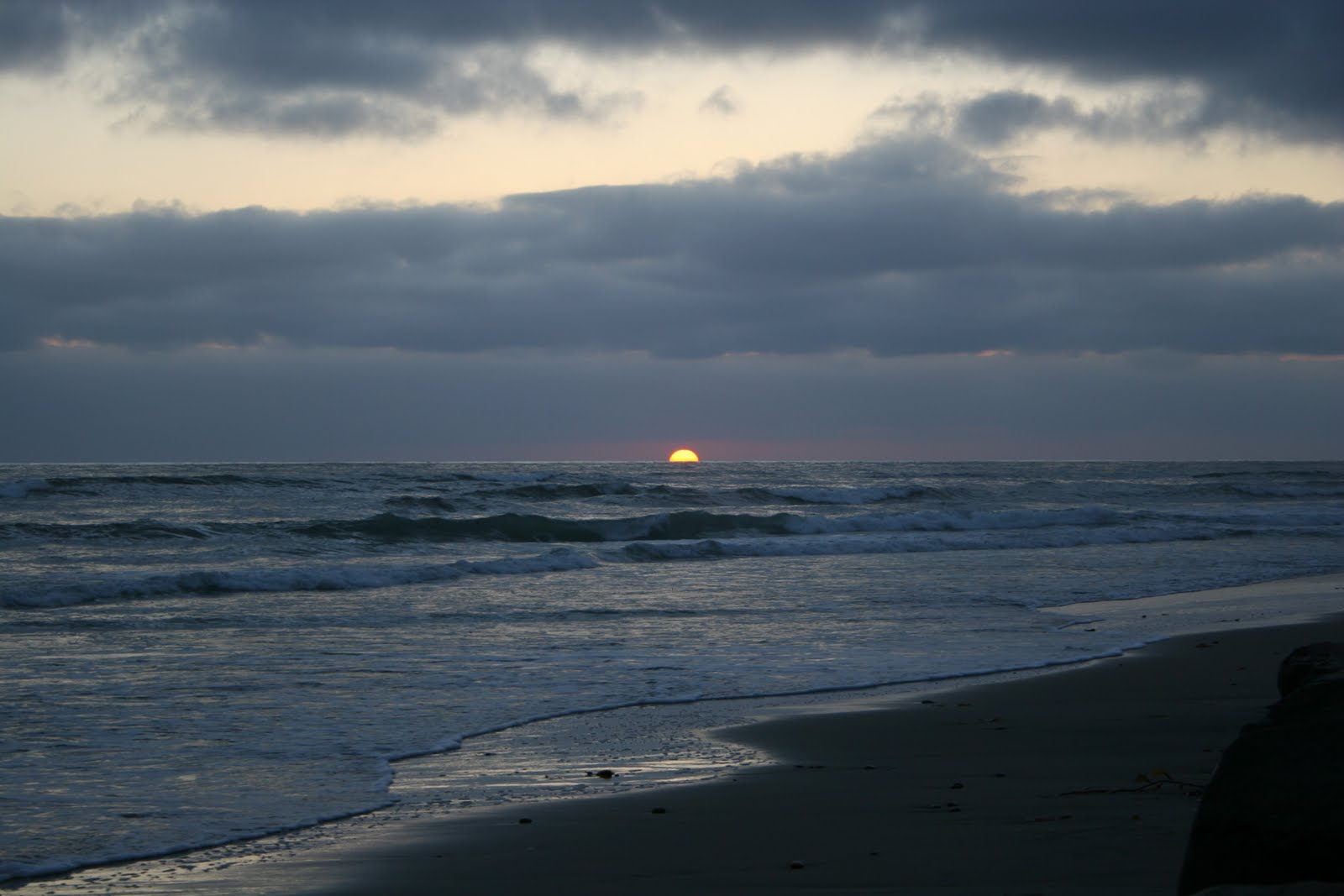
Can't help singing my 2nd favorite George Harrison tun with the alternate lyrics as our nearest stellar neighbor sinks slowly below the waves.... This image was taken with the kit lens at 55mm focal length with an exposure of 1/60 seconds at f/5.6, ISO 100.

Wednesday, June 30, 2010

Another view of a San Diego sunset

Another view of the setting sun near Encinitas California, north of San Diego. This image was taken with the kit lens at 18mm focal length with an exposure of 1/320 seconds at f/5.6, ISO 100.