The ISS flew over Southern Arizona tonight. I set up my new Canon 70D next to our 36 inch telescope and took some images with my 10mm fisheye lens. This one was exposed for 30 seconds at f/8, ISO 400 and shows the ISS trailed below the quarter phase moon with lots of clouds blowing by overhead. Our Spacewatch 1.8-m dome is at the bottom of the frame just left of center along with the Kitt Peak 36 inch to its right on the horizon and the WIYN telescope just right of that. The edge of our Spacewatch 36 inch telescope building is at the top right corner, heavily distorted by the fisheye lens.
This image shows the ISS setting over the lights of Tucson. Taken with my 10mm fisheye on my 70D, the 4-m Mayall telescope dome is heavily distorted at the left edge of the frame. The exposure for this image was 30 seconds at f/8, ISO 400.
Click on a photo to see a larger version of the image.
Monday, December 09, 2013
Saturday, December 07, 2013
Comet Lovejoy (C/2013 R1) over Tucson
Comet ISON (C/2012 S1) got all the press in the last month as it skimmed over the surface of the Sun on Thanksgiving, but all the while, comet C/2013 R1 Lovejoy was lurking in the morning skies just minding its own business. It's been a naked eye comet for more than a month, though it won't blow your eyeballs out and you'll probably need binocs to be sure you saw it. This image was taken from Kitt Peak with my new Canon EOS 70D with my trusty old Sigma 24mm f/1.8 lens set to f/1.8 at ISO 1600 with a 20 second exposure. Tucson lights up the sky rather brightly and you can see it at the bottom behind the mountains that are silhouetted against it. At the top near the center of the image is comet Lovejoy - a small greenish coma with a faint tail pointing up and to the left. You can also spot the constellation Hercules just above Tucson a little left of center and if you know where to look, you can even see Globular Cluster M-13.
Thursday, September 05, 2013
Backlit butterfly, bee and flowers.
Tuesday, August 20, 2013
Arizona Sonora Desert Museum: These Bighorn Sheep are a bunch of posers.
| One of the three Bighorn Sheep at the ASDM, posing as usual. This image was taken at 170mm focal length with an exposure of 1/160 seconds at f/5, ISO 400. |
| Another pose.... This image was taken at 180mm focal length with an exposure of 1/250 seconds at f/5, ISO 400. |
| This male is getting ready to climb down the artificial rock face. This image was taken at 180mm focal length with an exposure of 1/100 seconds at f/5, ISO 400. |
Monday, August 19, 2013
The Arizona-Sonora Desert Museum: Some parts of it really bug me.
| A pair of Tarantula Wasps work no this flower. This image was taken at 210mm focal length with an exposure of 1/320 seconds at f/5, ISO 800. |
| Another view of a Tarantula Wasp taken with an exposure of 1/250 seconds at f/5.6, ISO 800 with my telephoto at 300mm focal length. |
Arizona Sonora Desert Museum has all variety of plants and critters that inhabit our deserts and insects are amongst the most numerous residents of our desert. These insects were found around the corner from one another in an area rich in flowers which attract many insects, including butterflies which I couldn't quite get a focused picture of as he sat on a nearby flower.
Labels:
Arizona Sonora Desert Museum,
Flowers,
insects,
spider
Sunday, August 18, 2013
An evening at the Arizona Sonora Desert Museum - first up, the hummingbird enclosure
| This image was taken with my 75-300 zoom at 140mm focal length with an exposure of 1/125 seconds at f/5.0, ISO 800. This looks like a female Blue-throated Hummingbird. |
| This appears to be a male Calliope Hummingbird. This was shot at 300mm focal length with an exposure of 1/160 seconds at f/5.6, ISO 800. |
| This male Costa's Hummingbird was shot at 300mm focal length with an exposure of 1/160 seconds at f/5.6, ISO 800. |
Saturday, April 27, 2013
Wildlife day in Madera Canyon
So my sweetie and I are hiking in Madera Canyon, heading for my favorite little waterfall off a stream that was mostly dry today. As I came upon some water flowing, I was excited to see it and there was a small waterfall just above that that I was excited about. As I climbed over some rocks to the stream bed above the small waterfall, I was about 50 feet ahead of my sweetie. I did a double take when I saw two furry forms ahead - a larger black bear and a smaller brown bear - mom and cub, I assumed. They were probably about 40 feet away. I backed away rather quickly and as I started down the rocks next to the small waterfall, I started calling out to Karri - "go back, quickly!" - I wanted her to get some more distance between her and the bears in case they decided to be aggressive. All she could say as I stood there was "Why?" I looked back and the bears were moving off to the side of the stream and uphill. All this time, I had 4 cameras, my 20D with my 75-300mm telephoto in place and my sx260 on my hip, an older P&S in my bag and of course my smartphone and instead of pulling any of them out, I was working on getting some distance between me and the bears! So I missed the best picture, but now as they were slowly moving uphill, they were showing no signs of threatening us, so I pulled out my 20D and snapped a couple shots - none that great, but here's the best of the 4 pictures I took with the 75-300mm lens at 180mm focal length and an exposure of 1/80 seconds at f/8, ISO 100:
Later, on the way back to the trailhead, this deer crossed the trail ahead of me and went down by the stream. We slowly made our way down the trail and the deer at first did not hear or see us coming and then continued feeding on the grass next to the stream as he kept an eye on us. This next image was taken with my 20D with my 75-300mm lens at 135mm focal length with an exposure of 1/100 seconds at f/4.5, ISO 400.
![]() |
| We also saw the usual supply of lizards - this image was taken with my SX260HS with an exposure of 1/2000 seconds at f/8, ISO 1600. |
![]() | ||||||||
As we were leaving Madera Canyon we passed a flock of Turkeys with this guy showing off his plumage for the camera.
|
Friday, March 15, 2013
Comet PAN-STARRS, the Moon and the San Xavier Mission
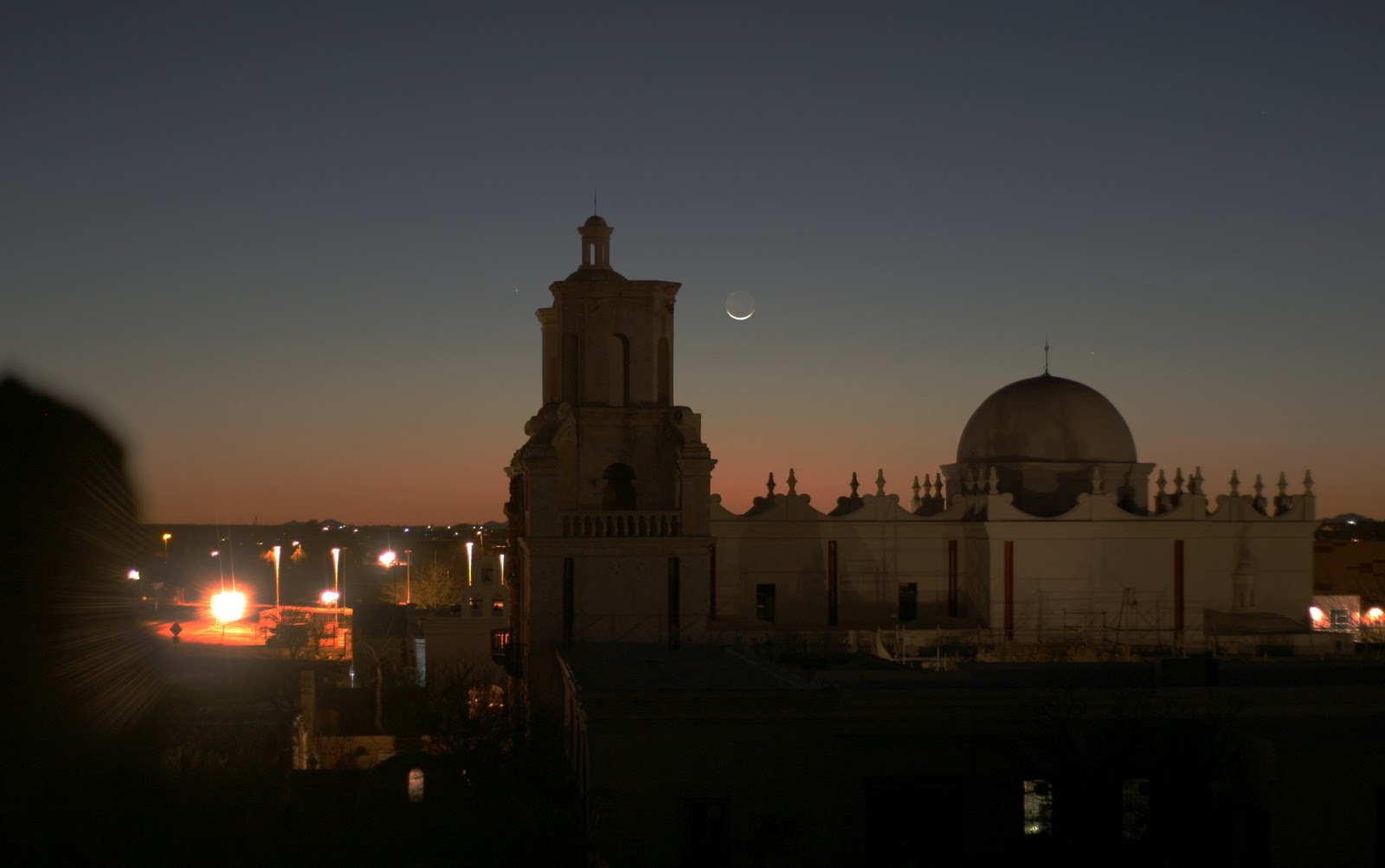
On Tuesday night, March 12, comet C/2011 L4 PAN-STARRS was closest to the crescent Moon and a little easier to see in the twilight sky. I took advantage of the alignment by heading down to the San Xavier Mission southwest of Tucson. In this image, you can see the crescent Moon to the right of the missions tower while the comet is just left of the tower at almost the same height as the Moon. This image was taken with my 50mm lens on my 20D with an exposure of 1 second at f/1.8, ISO 200.
Comet PAN-STARRS is so close to the Sun that it sets very quickly, only about an hour after sunset and about half an hour after the sky has darkened enough to see the comet. Here, the front towers of the Mission are just right of the setting crescent Moon with the comet just above the 2nd lamp left of the small mission tower left of the Moon. This image was taken with my 50mm lens and an exposure of 2 seconds at f/1.8, ISO 400.
Thursday, November 01, 2012
Endeavour in the streets of LA
We traveled to L.A. to watch the "Endeavour Parade" as the Space Shuttle Endeavour was transported along city streets from LAX all the way to Exposition Park and the California Science Center, a 15 mile journey that was planned to take almost two full days. We got to L.A. on Friday morning and Endeavour left LAX around 2 AM. We found a busy city with closed streets but found a parking spot along a street one block from Manchester Avenue not far from LAX where it was schedule to roll past around 2PM in the afternoon after a stop to reconfigure the transporter. We found our viewing site at Wiley Post and Manchester. The crowds grew and finally, we could see the tail of the orbiter appear and it slowly moved past us at 2 mph. This view was taken with my 24mm lens with an exposure f/9 and 1/400 seconds at ISO 100.
As it slowly passed us, I was able to change lenses and get some closeups of the orbiter which flew 25 missions into space. The thermal blankets used around the upper part of the fuselage around the cockpit show their structure as well as the wear and tear of flying to and from space. This image was taken with my 75-300mm telephoto at 190mm focal length with an exposure of 1/800 seconds at f/9, ISO 100.
Another closeup of the tiles on the side of the orbiter shows the streaking on the black tiles due to re-entry heating on the tiles. You can also see that each of the tiles had an identification number printed on it. This image was taken at 300mm focal length with an exposure of 1/100 seconds at f/9, ISO 100.
"Cut Her for Emergency Rescue" was happily never used but this shows rescue personnel where an area of the cockpit designed to be cut through more easily was so they could access the crew compartment if needed. You can also see the serial numbers on the thermal blankets and the stitching in them. This image was taken at 300mm focal length with an exposure of 1/500 seconds at f/9, ISO 100.
The nose of the Endeavour housed the forward Reaction Control System engines that were used to orient the orbiter in space as well as to make fine adjustments to its velocity. In front of the RCS is the grey colored nose cape that had to withstand some of the highest temperatures on the orbiter during its re-entry into the Earths atmosphere. The entire RCS module could be removed for servicing between missions if needed. The RCS used hypergolic propellants that would ignite when the fuel and oxydizer came into contact - a reliable but rather difficult fuel to use. This image was taken at 75mm focal length with an exposure of 1/160 seconds at f/9, ISO 100.
Tuesday, September 04, 2012
You Old Fossil
These first two images are on a layer in the Quarry site at Dinosaur National Monument which is preserved for visitors inside a building. These bones are about 150 million years old - farther back in time from the K-T boundary when the Dinosaurs went extinct 65 million years ago than the K-T boundary is from us today. The bones collected in this layer most likely after dying elsewhere and being washed downstream before collecting in a common area over millions of years. both images were taken with my 24mm lens and an exposure of 1/80 seconds at f/4, ISO 400
This image finally gives you some scale for the size of the bones - notice the gentleman and his son at the bottom right of the layer of bones visible here. They are generally quite large. This layer extended in all 4 directions, left, right, up and down. It was excavated starting in about 1910 by Earl Douglass from the Carnegie Museum in Pittsburgh. They removed huge layers of rock and dirt to get to the layers that contained the dinosaur bone fossils like these.
Another pair of views of the wall of dinosaurs - you can see how small we humans are in the 2nd view. The last 3 images were all taken with my 24mm lens and an exposure of 1/60 seconds at f/4, ISO 400.
A closeup of a segment of vertabrae with my 75-300mm lens at 120mm focal length with an exposure of 1/50 seconds at f/4.5, ISO 400.
Monday, September 03, 2012
Dinosaur Double Rainbow
We arrived at the Quarry Visitor Center entrance to Dinosaur National Monument near Jensen Utah just before sunset. As we headed for a campground in the park, we were treated to this rainbow show. This image was taken with my 24mm lens and an exposure of 1/250 seconds at f/2.5, ISO 400.
I put my 10mm fisheye lens on to capture the full rainbow - the inner rainbow is complete while the outer one is visible over more than half the arc, maybe more with a little imagination. This image was taken with an exposure of 1/30 seconds at f/2.8, ISO 100.
The sunlit cliffs were dramatic along with the rainbow. This image was taken with my 75-300mm lens at 75mm focal length and an exposure of 1/100 seconds at f/4, ISO 400.
I put my 10mm fisheye lens on to capture the full rainbow - the inner rainbow is complete while the outer one is visible over more than half the arc, maybe more with a little imagination. This image was taken with an exposure of 1/30 seconds at f/2.8, ISO 100.
The sunlit cliffs were dramatic along with the rainbow. This image was taken with my 75-300mm lens at 75mm focal length and an exposure of 1/100 seconds at f/4, ISO 400.
Sunday, September 02, 2012
Flaming Gorge geology
As we approached the south end of Flaming Gorge National Recreation Area, we found ourselves in an area with stratified cliffs showing the geology of the area in spectacular views. This image was taken with my 75-300mm lens at 75mm focal length with an exposure of 1/800 seconds at f/5.6, ISO 200.
The top of this cliff has an interesting layer a few feet thick that differs from adjacent layers. This image was taken at 75mm focal length with an exposure of 1/1000 seconds at f/5.6, ISO 200.
A closeup of a few layers in a cliff wall. This image was taken at 75mm focal length with an exposure of 1/400 seconds at f/5.6, ISO 200.
Finally a view of the lake that fills the Flaming Gorge Recreation Area from the roadway at one of the scenic viewpoints. We could see boats and water skiers. This image was taken with my 24mm lens and an exposure of 1/125 seconds at f/11, ISO 100.
This last image shows a number of boats on the lake including one with a skier in tow. This image was taken at 300mm focal length with an exposure of 1/200 seconds at f/11, ISO 100.
The top of this cliff has an interesting layer a few feet thick that differs from adjacent layers. This image was taken at 75mm focal length with an exposure of 1/1000 seconds at f/5.6, ISO 200.
A closeup of a few layers in a cliff wall. This image was taken at 75mm focal length with an exposure of 1/400 seconds at f/5.6, ISO 200.
Finally a view of the lake that fills the Flaming Gorge Recreation Area from the roadway at one of the scenic viewpoints. We could see boats and water skiers. This image was taken with my 24mm lens and an exposure of 1/125 seconds at f/11, ISO 100.
This last image shows a number of boats on the lake including one with a skier in tow. This image was taken at 300mm focal length with an exposure of 1/200 seconds at f/11, ISO 100.
Saturday, September 01, 2012
Bighorn Sheep
After leaving Yellowstone, we drove south, heading for Dinosaur National Monument. As we neared the Flaming Gorge National Recreation Area, I saw a car pulled off to the side of the road at the junction of a dirt road. A lady had her camera out so I grabbed mine and quietly walked up the dirt road and was treated to a group of Bighorn Sheep that she was photographing. Here are a few of them.
This image was taken at 300mm focal length with an exposure of 1/640 seconds at f/5.6, ISO 200.
This image was taken at 90mm focal length with an exposure of 1/800 seconds at f/5.6, ISO 200.
This image was taken at 200mm focal length with an exposure of 1/800 seconds at f/5.6, ISO 200.
This image was taken at 300mm focal length with an exposure of 1/640 seconds at f/5.6, ISO 200.
This image was taken at 90mm focal length with an exposure of 1/800 seconds at f/5.6, ISO 200.
This image was taken at 200mm focal length with an exposure of 1/800 seconds at f/5.6, ISO 200.
Friday, August 31, 2012
Lewis River and the Moon in twilight
This HDR combine was shot while I waited for some visitors who hopped out of their car and put themselves right in the middle of the frame for the photos of Lewis Falls from the north end of the bridge here. I knew the contrast between the darkened scenery and the bright twilight sky and Moon would be tough to catch in a single exposure, so I took 3 images bracketed by 1 stop around 1 second at f/4, ISO 100 with my fisheye lens.
This HDR combine really paid off compared with the original bracketing exposures. I used 4 exposures in this case thanks to mis-setting my first attempt here - now I wish my old Canon 20D could take 5 bracketed images automatically. The central exposure in the bracket was 2 seconds at f/8, ISO 400 with my 24mm lens.
Here is one of the original frames that went into the above HDR combine with the central exposure.
This HDR combine really paid off compared with the original bracketing exposures. I used 4 exposures in this case thanks to mis-setting my first attempt here - now I wish my old Canon 20D could take 5 bracketed images automatically. The central exposure in the bracket was 2 seconds at f/8, ISO 400 with my 24mm lens.
Here is one of the original frames that went into the above HDR combine with the central exposure.
Subscribe to:
Posts (Atom)